Note: The four points in the figure correspond to the four scenarios described in the main text – that an off-the-shelf AI-system license costs 2000/4000 DKK and that the systems are used 60/80 per cent effectively by public employees.
Source: Own calculations based on O*NET, the US Bureau of Labor Statistics and Statistics Denmark.
With these assumptions, we calculate the number of public employees for whom the value of the working time freed exceeds the cost of a licence. The results are shown for each scenario in Figure 5 below, with the range between them highlighted to show the uncertainty. Across the four scenarios, a licence is cost-effective for approximately 435,000–516,000 public employees (full-time equivalents), at an annual licence expenditure of DKK 0.9–1.9 billion.
Of the theoretical potential of 28,000 FTEs from secure and compliant off-the-shelf AI assistants, we estimate that 11,000–17,000 FTEs of working time could be realised cost-effectively. The working time freed has an estimated wage-equivalent value of DKK 7–10.5 billion annually, net of training time.
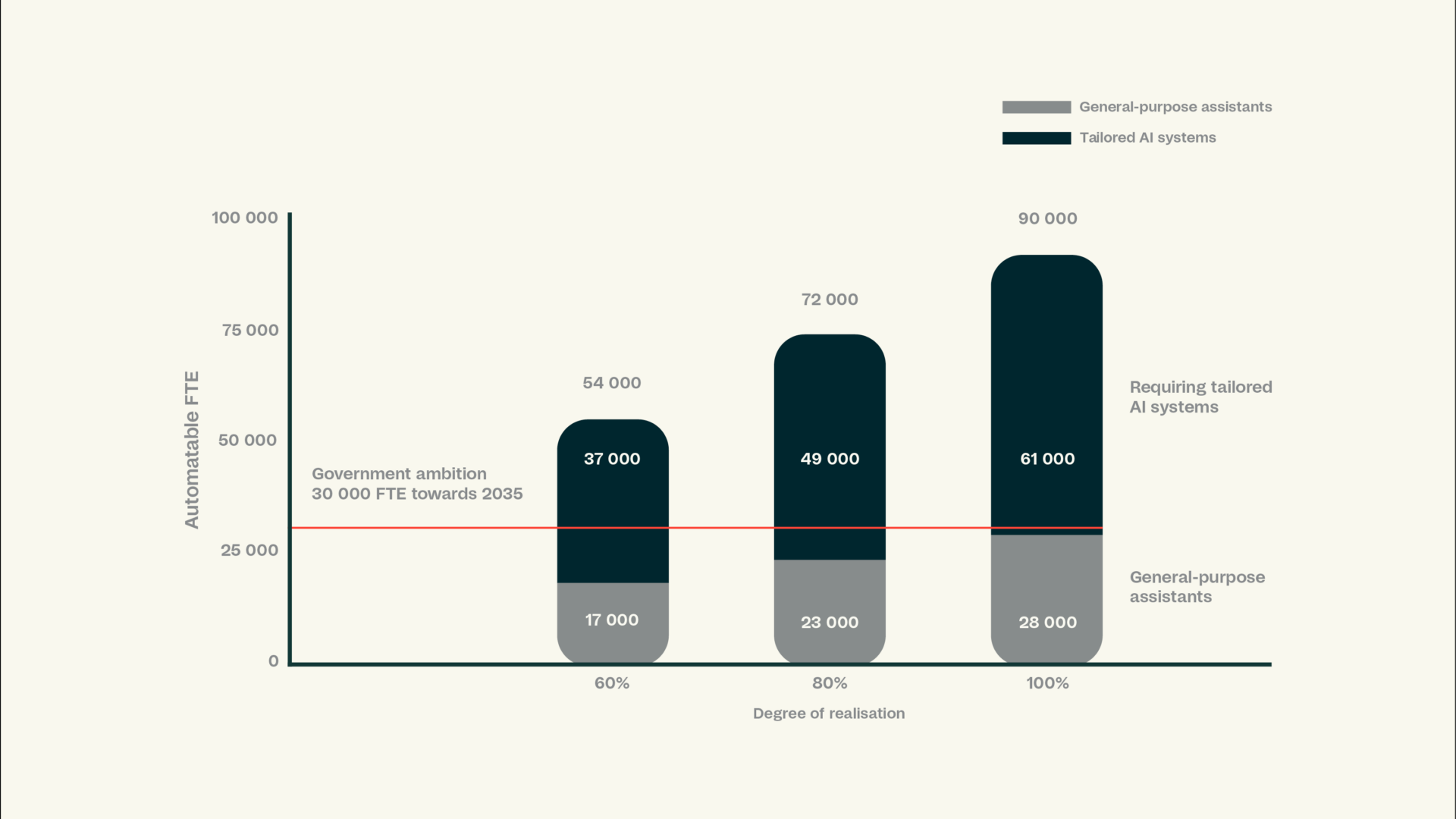
The results show four points of optimal investment in off-the-shelf AI-systems given the assumptions in the four scenarios. The main take-away is that even the most optimistic scenario only gets about halfway to the national target of 30,000 FTEs. Reaching it thus entails use of tailor-made systems in large shares of public processes already in use by 2035.
AI in critical public processes creates sovereignty dilemmas
Operational resilience requires that critical public functions do not depend on technologies, models or compute that external actors can unilaterally restrict or withdraw; data sovereignty, that governments retain control over sensitive public data; and autonomy, that they can switch technologies or providers when circumstances change.
Dependencies take several forms. Systems hosted outside Europe may be exposed to decisions by foreign governments, and even infrastructure in Europe may be operated by companies under foreign jurisdiction. Limited competition and vendor lock-in can make switching costly, and access to the models themselves can be restricted, as the temporary US export controls on Anthropic’s leading models in June 2026 illustrate.
Control over advanced chips, computing power and AI models is increasingly intertwined with economic and foreign policy, which makes these dependencies geopolitical: a commercial dependency can become a strategic vulnerability when regulation or international relations change. The safeguards discussed in this paper must therefore be accompanied by scrutiny of the infrastructure underlying AI systems.
European providers hold only around 15 per cent of the European cloud market, and Europe depends on foreign providers of leading AI models and advanced chips. Expanding Europe’s options requires substantial investment in computing, datacentre and energy capacity; growing public-sector demand could help create a market for European alternatives.
Such capacity will take time to build and will not remove the need for global technology. Governments must therefore continue to assess where control is essential and where dependencies can be accepted and managed – diversifying providers and keeping models and infrastructure substitutable where possible. Infrastructure, access and control will thus be central to how Denmark captures the productivity gains while maintaining a legitimate, trusted and resilient public sector.
30,000 FTEs is an achievable target – if Denmark builds for it
Denmark faces decades where demand for welfare services grows faster than the workforce that supplies them. Our results suggest that AI systems can close much of the gap: a feasible potential of 90,000 FTEs – a capacity corresponding to DKK 54 billion a year in wage terms – against a national target of 30,000. The target does not require technological optimism; it requires realising around a third of what is already feasible with today’s technology under today’s administrative standards.
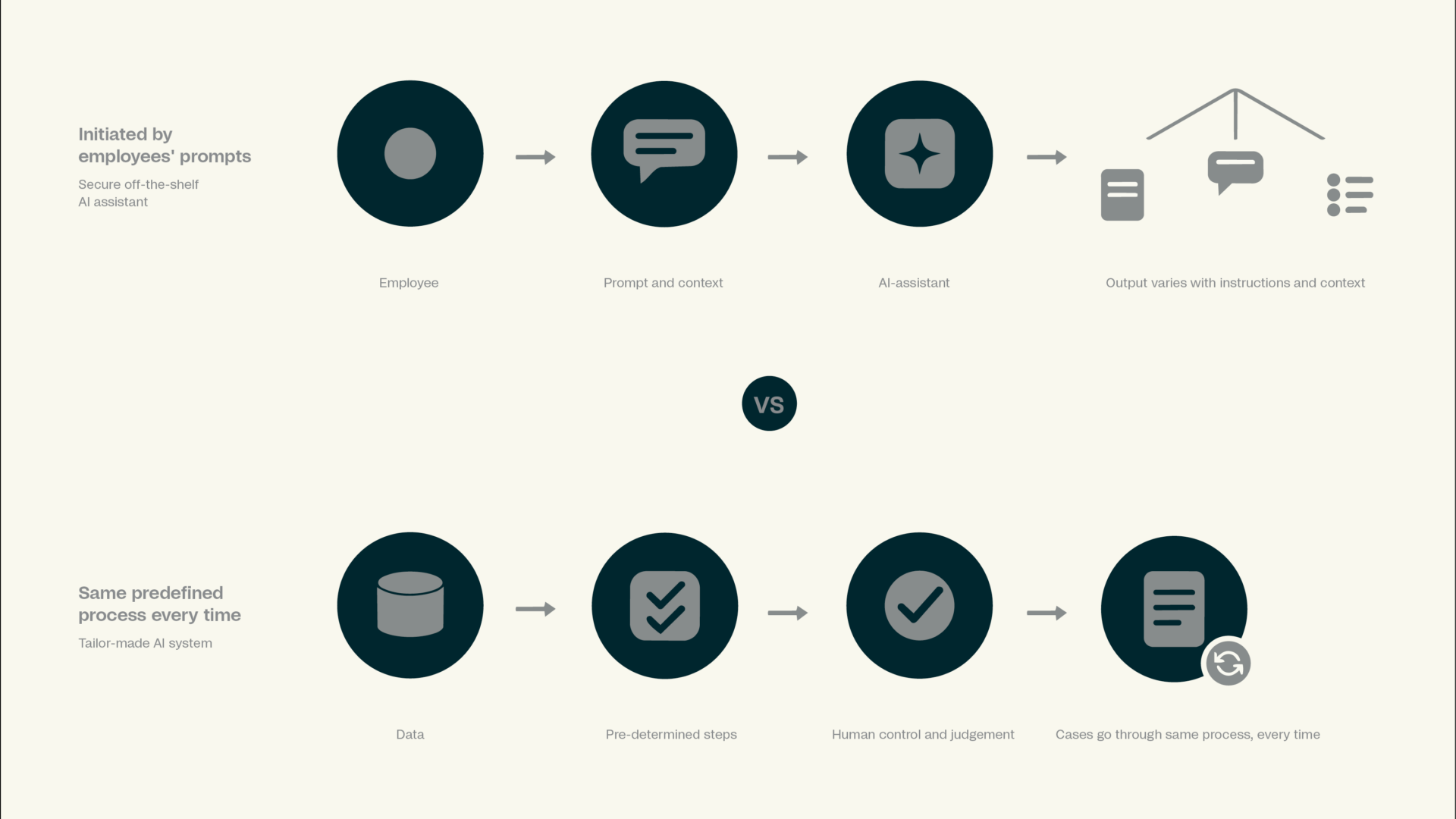
It does, however, require the right kind of effort. Over two-thirds of the potential depends on tailored AI systems built to the standards that make public administration lawful and trusted. While the remainder is technically reachable with off-the-shelf assistants, going from theoretical potential to realised gains reduces this further. We estimate that cost-efficient implementation of off-the-shelf AI-assistants would realistically increase capacity by about 15,000 FTEs for an estimated investment of 900 to 1,900 million DKK.
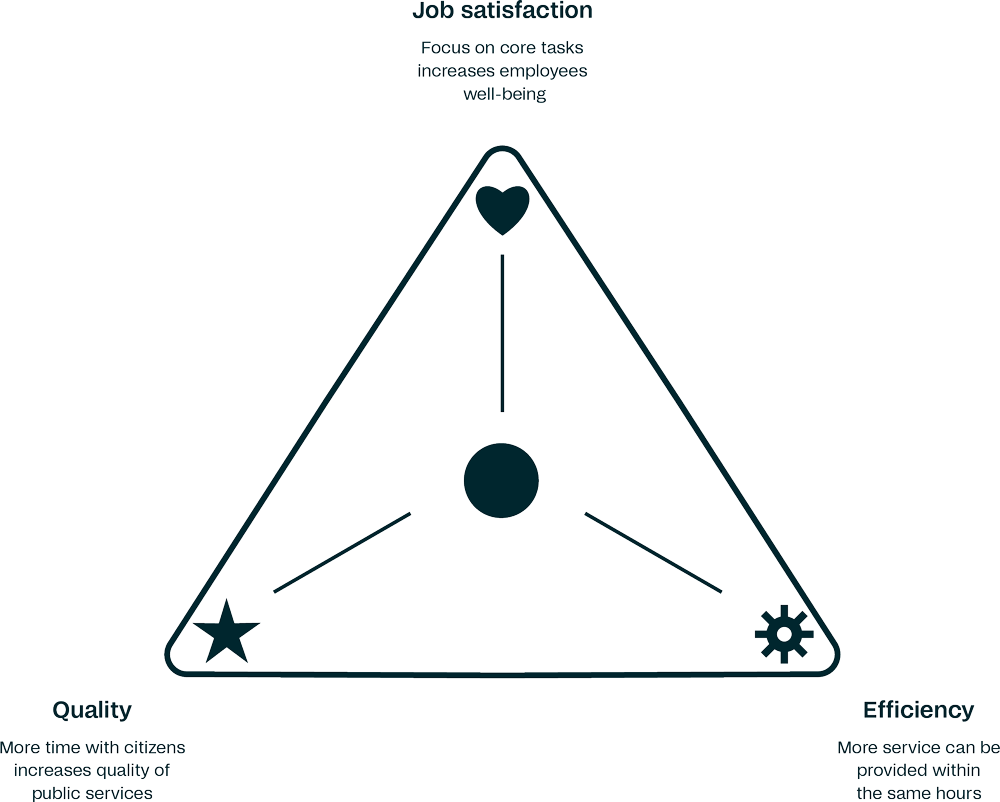
Most of the gains from off-the-shelf AI assistants are in education, research and health where time saved is inherently harder for management and policymakers to consolidate and redirect. This emphasises the point that policymakers should be explicit about what they want freed capacity to achieve. Redirecting capacity to new tasks or reducing staffing needs may point to automating administration, whereas more face-to-face time with citizens could also be gained in education, care or health. Either way, large parts of public-sector employment must be covered in any policy aimed at reaching the national target, and the necessary systems must be scoped, built and in daily use well before 2035.
Finally, because these systems will sit inside critical public processes, control over the infrastructure beneath them becomes part of the policy decision. Overreliance on vendors outside Europe puts Denmark at a strategic disadvantage and creates new geopolitical pressure points. While this reliance cannot be avoided completely, a decision to invest in the underlying infrastructure can increase control over the technology stack on which public processes will run in the future.
Welfare states are under pressure everywhere, and Denmark’s is no exception. AI technology offers a rare chance to shrink the time absorbed by administration while preserving the quality and legitimacy of public services. Seizing it requires no technological breakthrough – only broad and sensible implementation, in which AI systems are made to meet the standards of good administrative practice rather than allowed to redefine them.
Endnotes
[1] Danish Ministry of Digital Affairs, “Kunstig intelligens skal frigøre mere tid til det vigtige”, 10 June 2025. The announcement sets out a joint ambition to free up at least 50 million hours, equivalent to at least 30,000 full-time equivalents (FTEs), by 2035, with a significant share realised by 2030.
[2] This analysis distinguishes between off-the-shelf AI assistants and tailor-made AI systems. The former help public employees with general tasks using information provided by the employee, requiring minimal system integration. The latter address tasks requiring greater consistency, transparency and oversight throughout the process to comply with public-administration requirements. The distinction is elaborated on p. 4.
[3] Shakked Noy and Whitney Zhang (2023), “Experimental Evidence on the Productivity Effects of Generative Artificial Intelligence”, Science 381(6654), pp. 187–192.
[4] Erik Brynjolfsson, Danielle Li and Lindsey Raymond (2025), “Generative AI at Work”, Quarterly Journal of Economics 140(2), pp. 889–942.
[5] Daniel Schwarcz, Sam Manning, Patrick Barry, David R. Cleveland, J. J. Prescott and Beverly Rich (2026), “AI-Powered Lawyering: AI Reasoning Models, Retrieval Augmented Generation, and the Future of Legal Practice”, Journal of Law and Empirical Analysis 3(1).
[6] IMF (2024), Gen-AI: Artificial Intelligence and the Future of Work, Staff Discussion Note SDN/2024/001.
[7] Paweł Gmyrek, Janine Berg and David Bescond (2023), Generative AI and Jobs: A Global Analysis of Potential Effects on Job Quantity and Quality, ILO Working Paper 96.
[8] OECD (2026), The OECD AI Exposure Measure: Mapping the OECD AI Capability Indicators to Occupations.
[9] Folketingets Ombudsmand, Myndighedsguiden, overview no. 13, “Forvaltningsretlige krav til offentlige it-systemer”.
[10] Folketingets Ombudsmand (2025), FOB 2025-13 (Vurderingsstyrelsen); opening letter, case no. 25-05712, October 2025; and Ejendomsvurderinger – Vurderingsstyrelsens mulighed for at forklare boligejere om bagvedliggende beregninger mv. for en vurdering.
[11] DR, “Jonas var ikke i tvivl, og han fik ret: Kommunen brugte AI og brød reglerne”, 5 July 2026.
[12] Ingeniøren, “Kommune brugte AI i smug med lukkede øjne: Vagthund gransker nu sagen”, 23 June 2026.
[13] US Department of Labor, O*NET Resource Center (2023), O*NET Database, release 27.2.
[14] Since time studies of Danish public-sector employment are almost non-existent, we assume that the distribution of time spent on tasks within occupations follows the pattern in the US dataset. Where possible, we use Danish time studies to calibrate our results.
[15] Authors’ calculations using Statistics Denmark’s LONS20 data for 2024.
[16] “Administration” covers administrative and clerical occupations across the public sector—office clerks, secretaries, economists, lawyers, HR staff and similar occupations—regardless of the subsector in which they work.
[17] Authors’ calculations using Statistics Denmark’s LONS20 data for 2024.
[18] McKinsey & Company (2023), Det økonomiske potentiale af GenAI i Danmark, figure 10, pp. 26–27.
[19] Authors’ calculations applying the open occupational scores from Paweł Gmyrek et al. (2025), Generative AI and Jobs: A Refined Global Index of Occupational Exposure, ILO Working Paper 140, International Labour Organization and NASK.
[20] Authors’ calculations applying the open occupational task-exposure classifications from Tyna Eloundou, Sam Manning, Pamela Mishkin and Daniel Rock (2024), “GPTs are GPTs: Labor Market Impact Potential of LLMs”, Science 384(6702), pp. 1306–1308.
[21] Théodore Renault (2025), The Impact of Artificial Intelligence on Denmark’s Labor Market, IMF Selected Issues Paper No. 2025/119.
[22] Ole Teutloff, Johanna Einsiedler and Fenja Søndergaard Møller (2024), Large Language Models and the Danish Labour Market, Statistics Denmark Analysis No. 2024:02.
[23] Kim Abildgren and Rasmus Mose Jensen (2026), Artificial Intelligence Can Boost Productivity in the Danish Economy, Danmarks Nationalbank Analysis No. 6.
[24] Ninja Ritter Klejnstrup and Anders Gotfredsen (2024), Stort potentiale for automatisering af danske jobs, Kraka-Deloitte.
[25] Boston Consulting Group (2024), GenAI – et væsentligt potentiale for den danske offentlige sektor i 2040, prepared for Dansk Arbejdsgiverforening.
[26] Isabel Atkinson and James Browne (2024), The Potential Impact of AI on the Public-Sector Workforce, Tony Blair Institute for Global Change.
[27] The Tony Blair Institute made the same assumption in 2024. AI courses offered to public employees in Denmark range from a few hours to full days. Two workdays per year would cover these courses as well as self-directed learning on the job.